
When buyers receive a Certificate of Analysis for 1,1,3,3-Tetramethyldisiloxane (TMDSO), CAS 3277-26-7, purity is usually the first number they check.
But a TMDSO COA can tell you much more than whether the material simply meets a purity specification.
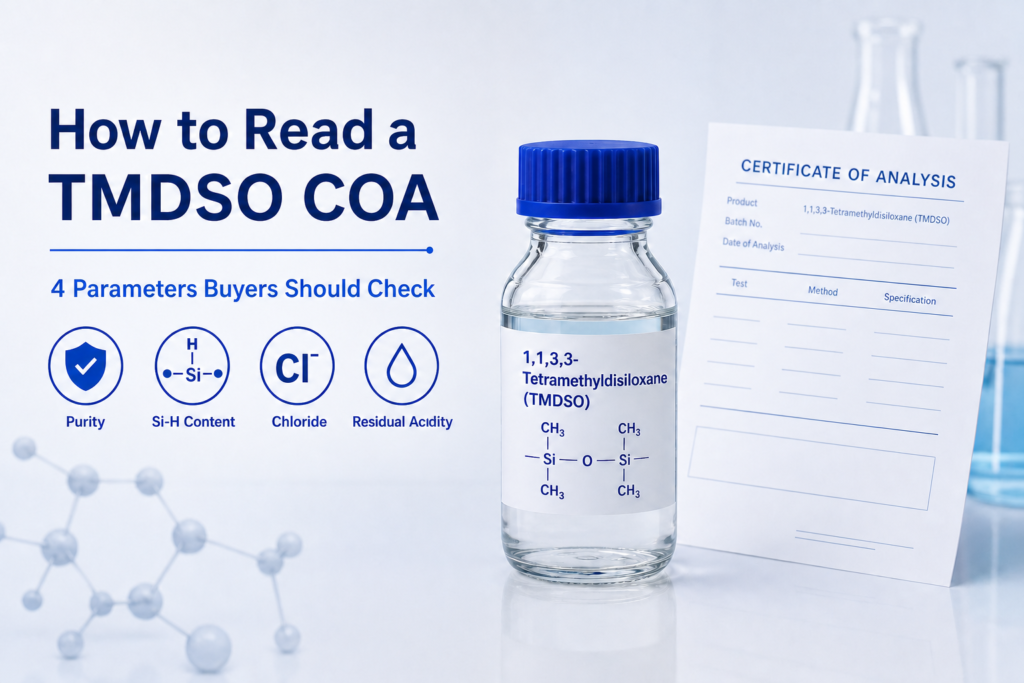
For buyers evaluating a new supplier, I would normally look at four parameters together:
Purity, Si-H content, chloride and residual acidity.
The goal is not only to confirm whether one batch passes the specification.
The more important question is whether the supplier can provide consistent material when you move from sample evaluation to commercial purchasing.
Why a TMDSO COA Matters
A Certificate of Analysis is one of the most useful documents when evaluating a new TMDSO source.
However, buyers should distinguish between two types of information:
- Specification limits
- Actual batch results
For example, a specification may state:
Purity ≥99.5%
This tells you the minimum acceptable requirement.
But the actual result tells you what was measured in that specific production batch.
When evaluating a supplier, I recommend reviewing both.
A specification tells you what the supplier promises to control.
Actual COA results help you understand how consistently that specification is being achieved.
The 4 Parameters I Would Check on a TMDSO COA
| Parameter | ETOPDA TMDSO Specification |
|---|---|
| Purity | ≥99.5% |
| Si-H Content | ≥1.39 wt% |
| Chloride | ≤10 ppm |
| Residual Acidity | ≤10 ppm |
Actual batch results are available in the latest COA upon request.
1. Purity
Purity by GC is normally the first parameter buyers compare.
For our current TMDSO grade, the specification is:
Purity ≥99.5%
However, buyers should not stop at the specification limit.
Look at the actual result of the batch and, where possible, compare several recent production COAs.
A single good result is useful.
Several comparable results are more informative when evaluating batch consistency.
2. Si-H Content
TMDSO contains reactive silicon-hydrogen bonds, which is why Si-H content deserves particular attention in applications involving hydrosilylation and other Si-H-sensitive reactions.
For our current specification:
Si-H Content ≥1.39 wt%
Rather than evaluating purity and Si-H separately, I normally recommend reviewing them together.
Purity gives an indication of overall material composition, while Si-H content provides additional information about the reactive hydrogen functionality of the material.
For a more detailed explanation, refer to our technical guide:
Why Si-H Content Matters When Evaluating TMDSO Quality
3. Chloride
Trace chloride can be important in sensitive downstream processes.
One common purchasing mistake is assuming that high GC purity automatically means chloride is also low.
That is not necessarily the best way to evaluate the material.
If chloride matters to your application, check whether it is separately controlled and reported on the COA.
For our current TMDSO specification:
Chloride ≤10 ppm
4. Residual Acidity
Residual acidity is sometimes overlooked because buyers tend to focus first on purity.
However, depending on the downstream process, acidity may influence reaction control, material stability or equipment compatibility.
For our current TMDSO specification:
Residual Acidity ≤10 ppm
Again, the specification limit is only one part of the evaluation.
The actual batch result can provide additional information when comparing suppliers or monitoring long-term consistency.
Specification Limit vs. Actual Batch Result
This distinction is particularly important when reading a COA.
Consider two suppliers.
Both may list:
Purity ≥99.5%
On paper, their specifications look identical.
But their actual production results and batch-to-batch variation may be different.
That is why I normally recommend asking for more than one recent COA when qualifying a new TMDSO supplier.
Instead of asking only:
“Does the product meet the specification?”
Also ask:
“How consistently does the supplier achieve these results across different batches?”
This is especially important when the material will be used in a repeat production process.
Why One COA May Not Be Enough
One COA tells you about one batch.
It does not automatically tell you about long-term production consistency.
When evaluating a new TMDSO source, buyers may want to request two or three recent batch COAs and compare:
- Purity
- Si-H content
- Chloride
- Residual acidity
- Test methods
- Specification limits
- Actual results
Large unexplained variation between batches may deserve further technical discussion before commercial approval.
Sample COA vs. Commercial Batch COA
A sample can help determine whether TMDSO works in your application.
But sample approval should not be the final step in supplier qualification.
Before moving to a commercial order, buyers may also want to confirm:
- whether the sample comes from the same production system used for commercial supply;
- whether the commercial product follows the same specification;
- whether a batch-specific COA will be supplied with each shipment;
- whether the supplier can provide comparable quality across future batches.
The objective is to reduce the gap between laboratory approval and commercial production.
A Quick TMDSO COA Checklist for Buyers
Before approving a TMDSO supplier, I would normally check:
- Is purity separately tested and reported?
- Is Si-H content included on the COA?
- Are chloride and residual acidity controlled?
- Are both specification limits and actual batch results shown?
- Can the supplier provide recent COAs from more than one batch?
- Are the test methods reasonably consistent?
- Will a batch-specific COA accompany commercial shipments?
- Does the specification match the buyer’s actual application requirement?
Final Thought
A TMDSO COA should not be treated as a simple pass-or-fail document.
Used properly, it can help buyers evaluate not only product quality, but also supplier consistency and commercial supply reliability.
For most sourcing decisions, I would not ask only:
“What is the purity?”
I would ask:
“What do the purity, Si-H content, chloride, residual acidity and recent batch results tell me together?”
If you are currently evaluating 1,1,3,3-Tetramethyldisiloxane (TMDSO), ETOPDA can provide a recent COA, technical specification and sample for evaluation.
If you already have a target specification, you are also welcome to share it so we can first check whether our current grade matches your application.