
When buyers compare 1,1,3,3-Tetramethyldisiloxane (TMDSO), CAS 3277-26-7, from different suppliers, purity is usually the first specification they look at.
That makes sense. Purity is easy to understand and easy to compare.
However, for TMDSO used in hydrosilylation and other Si-H-sensitive reactions, purity does not always tell the full story. This is why TMDSO Si-H content deserves specific attention.
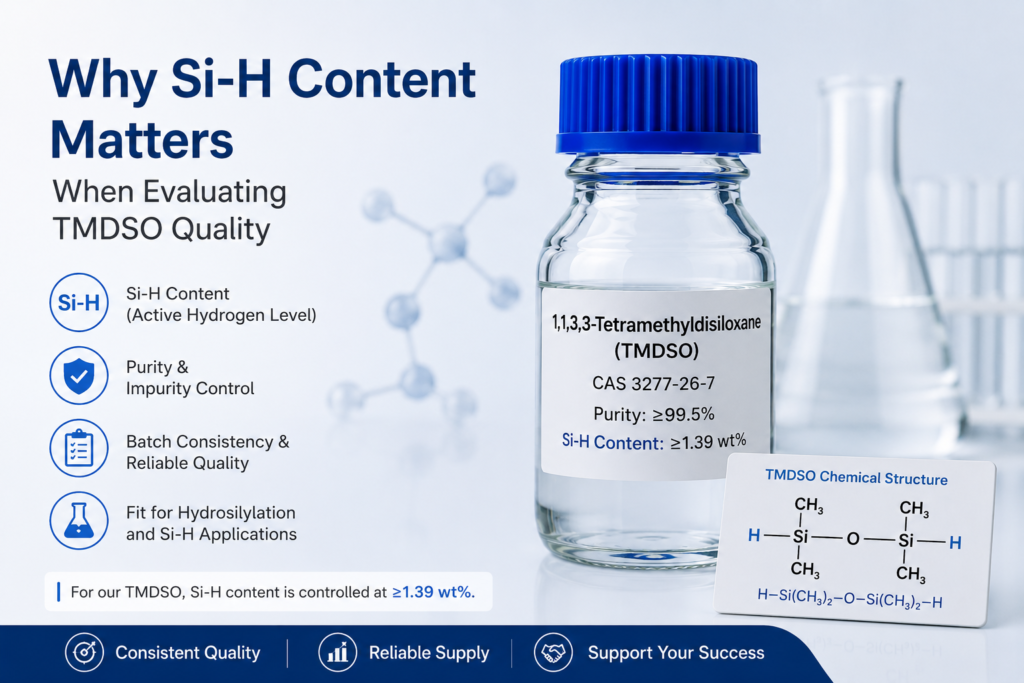
What Does Si-H Content Mean in TMDSO?
TMDSO contains reactive silicon-hydrogen bonds.
Si-H content indicates the level of active hydrogen associated with these reactive Si-H groups. For applications where TMDSO participates directly in hydrosilylation or other Si-H-related reactions, this parameter can help buyers evaluate whether the material has the expected reactive functionality.
In simple terms, purity tells you how much TMDSO is present, while Si-H content helps indicate whether the reactive functionality is where it should be. These two values should therefore be considered together rather than separately.
Why Can Two Similar Purity Results Perform Differently?
Imagine two batches of TMDSO both showing similar GC purity.
On paper, they may look almost identical.
But buyers using the material in a reaction process may also need to consider:
- Si-H content
- Trace chloride
- Residual acidity
- Batch-to-batch consistency
- Storage and handling conditions
Depending on the downstream application, variation in these parameters may influence reaction control, reproducibility or product consistency.
This is why supplier qualification should go beyond a single purity number.
Why Batch Consistency Matters
A good sample result is important.
But commercial purchasing decisions should also consider whether similar results can be maintained over future production batches.
Buyers can compare several recent Certificates of Analysis rather than reviewing only one sample COA.
The question should not only be:
“Does this sample pass our test?”
It should also be:
“Can the supplier provide comparable quality consistently when we move to commercial quantities?”
Four TMDSO Parameters I Would Check on a COA
| Parameter | ETOPDA TMDSO Specification |
|---|---|
| Purity | ≥99.5% |
| Si-H Content | ≥1.39 wt% |
| Chloride | ≤10 ppm |
| Residual Acidity | ≤10 ppm |
Actual batch results are available in the latest COA upon request.
1. Purity
GC purity remains an important starting point. Buyers should compare both the specification limit and the actual batch result.
2. Si-H Content
For Si-H-sensitive applications, this is one of the most useful parameters to evaluate together with purity.
For our current TMDSO specification, Si-H content is controlled at ≥1.39 wt%.
The important point is not simply to compare one number between suppliers, but to determine whether the specification matches the application requirements and whether actual batches remain consistent.
3. Chloride
Trace chloride may be relevant for sensitive downstream processes.
Rather than assuming that high purity automatically means low chloride, buyers should check whether chloride is separately controlled and reported.
4. Residual Acidity
Residual acidity is another parameter worth reviewing, especially where downstream reaction stability or process control is important.
Both the specification limit and actual batch result should be considered.
Sample Approval Is Only the First Step
A laboratory sample can help determine whether a new TMDSO source is suitable.
But before moving to a commercial order, buyers may also want to confirm:
- whether the sample comes from the same production system used for commercial supply
- whether commercial batches follow the same specification
- whether recent batch COAs are available for comparison
- packaging options
- storage requirements
- dangerous-goods shipping arrangements
- import documentation requirements
This reduces the gap between sample approval and commercial supply.
For a broader view of moving from laboratory evaluation to dependable commercial production, see TMDSO in Selective Synthesis: From Laboratory Chemistry to Reliable Scale-Up.
What Should Buyers Ask a New TMDSO Supplier?
Instead of asking only:
“What is your purity and price?”
A more complete supplier evaluation could include:
- Can you provide recent batch COAs?
- How is Si-H content controlled?
- Are chloride and residual acidity included in routine testing?
- Can you provide a sample before commercial purchasing?
- How do you manage batch consistency?
- What packaging and dangerous-goods shipping options are available?
These questions usually provide much more information about a potential supplier than price comparison alone.
Final Thought
There is nothing wrong with comparing price.
And purity remains an important TMDSO specification.
But when TMDSO is being used as a functional intermediate rather than simply purchased as a commodity, the purchasing decision may require a broader quality review.
For many buyers, the more useful question is not:
“Which supplier has the highest purity?”
It is:
“Which supplier can provide the specification and consistency my process actually requires?”
If you are currently evaluating 1,1,3,3-Tetramethyldisiloxane (TMDSO), ETOPDA can provide a recent COA, technical specification and sample for evaluation.
You are also welcome to send us your target specification so we can review whether our current grade matches your application.